
When Mr. Shah retired three years ago, he did what felt like the responsible thing. His provident fund payout, his gratuity, the proceeds from selling a small plot of land: all of it went into fixed deposits across two banks. No risk, no surprises, a fixed sum credited to his account every quarter.
It still feels safe. But lately, the numbers have started to bother him. The interest credited last quarter was smaller than the one before, after tax was deducted. His grocery bill keeps climbing. And he's started wondering, quietly, whether "safe" is actually costing him more than he realizes.
If this sounds familiar, you're not alone, and you're not wrong to have chosen FDs. It's the instinct of a lifetime spent avoiding risk. But it's worth understanding, in plain numbers, what that instinct is actually costing you every month.
Quick Summary
FD interest is fully taxable and fixed in nominal terms, so its real value shrinks every year as inflation rises, even though the number on your statement stays the same. An SWP (Systematic Withdrawal Plan) offers an alternative: a fixed monthly payout drawn from a mutual fund investment instead of interest alone. This post covers:
- What an SWP actually is and how it differs from FD interest
- A direct comparison of how each is taxed and how each behaves over time
- What a real corpus could generate in monthly income, and the honest risks involved
- Where to go if you want to explore this further, without giving up your FDs entirely
Quick Answers
Is FD interest fully taxable? Yes. FD interest is added to your total income and taxed at your regular income tax slab rate, with TDS deducted at source once it crosses the threshold set by your bank.
What is an SWP in simple terms? A Systematic Withdrawal Plan lets you withdraw a fixed amount every month from a mutual fund investment, similar in feel to an FD interest payout, but drawn from a mix of capital and growth rather than interest alone.
Is an SWP guaranteed the way FD interest is? No. FD principal and interest are contractually fixed. An SWP is market-linked: the corpus can grow, shrink, or last a different number of years depending on how the underlying investment performs. This is a genuine tradeoff, not a strictly better option.
(Full answers to these and more are in the FAQ section below.)
What Is an SWP?
An SWP, or Systematic Withdrawal Plan, is a facility that lets you withdraw a fixed amount from a mutual fund investment at regular intervals, typically monthly. Instead of earning interest that gets paid out separately, your money stays invested and grows (or shrinks) based on market performance, and each withdrawal draws down a mix of your original capital and any returns the fund has generated.
For a retiree used to FD payouts, the monthly experience can feel quite similar: money lands in your account on a set date, in a set amount. What's different underneath is how that money is taxed, and what happens to your remaining corpus over time.
FD Interest vs. SWP: A Direct Comparison
| FD Interest | Mutual Fund SWP | |
|---|---|---|
| Taxation | Fully taxable at your income slab rate | Depends on fund type and holding period, often more tax-efficient than slab-rate interest |
| Return | Fixed, known in advance | Market-linked, varies year to year |
| Capital | Guaranteed by the bank (up to deposit insurance limits) | Not guaranteed; capital can grow or reduce based on markets |
| Real value over time | Erodes with inflation, since the nominal payout doesn't rise | Has the potential to keep pace with or beat inflation over the long term, though this isn't assured |
| Best suited for | Capital preservation, zero tolerance for fluctuation | Retirees comfortable with some variability in exchange for potentially better long-term outcomes |
The tax point is worth sitting with for a moment. If you're in the 20% or 30% tax slab, a meaningful chunk of every FD interest payout is gone before it even reaches your account. That's not a one-time cost. It repeats every single year, on every renewal, for as long as the money sits there.
What Could a Real Corpus Actually Generate?
Numbers help more than percentages here. Consider a retiree with a ₹1 crore corpus deciding between keeping it in FDs or moving it into a withdrawal plan.
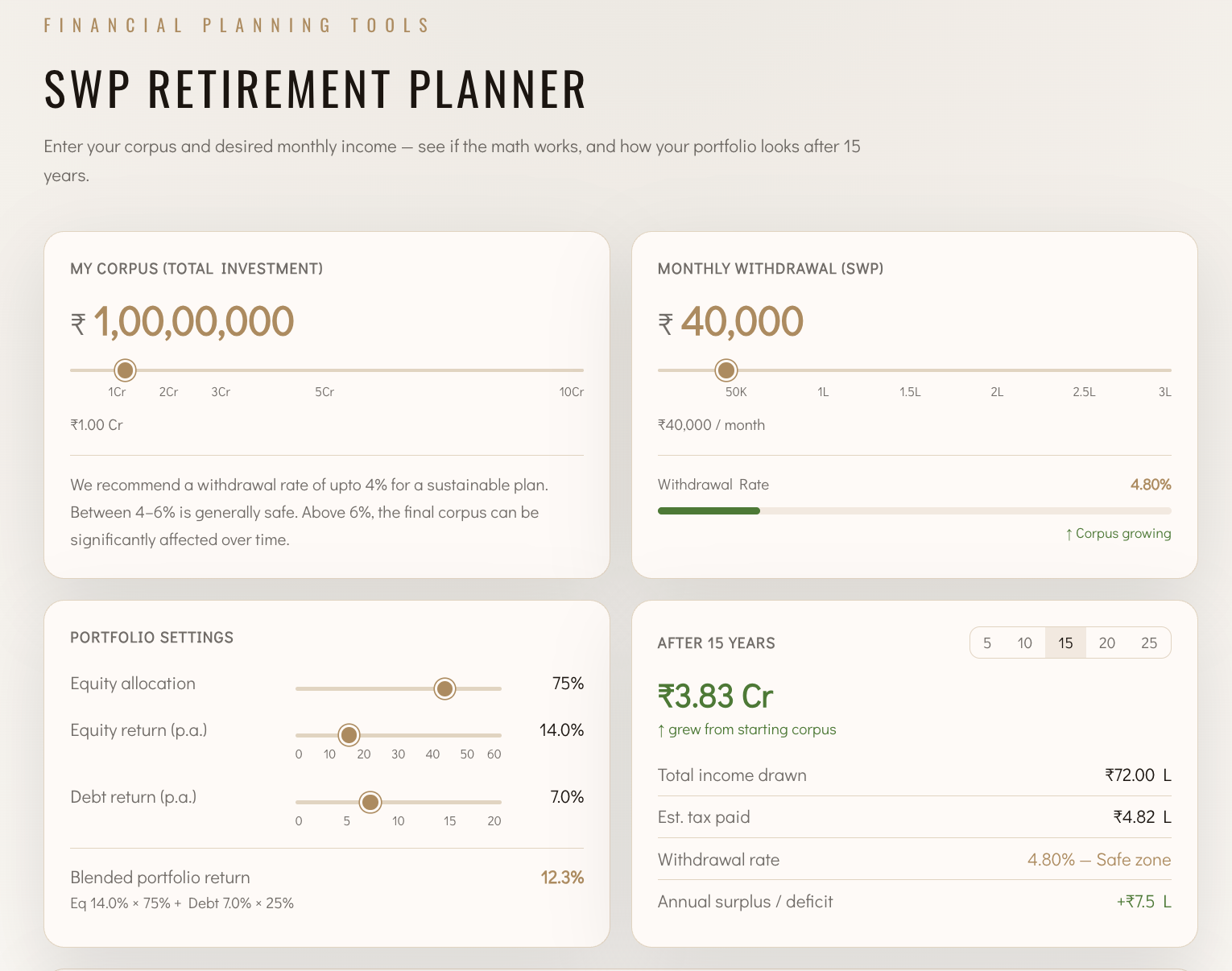
Entering a ₹1 crore corpus with a ₹40,000 monthly withdrawal works out to a 4.8% annual withdrawal rate, comfortably within the calculator's "safe zone." This is illustrative only, based on assumed rates of return, and not a promised or assured outcome; actual results depend on market performance and the specific funds chosen.
Want to see what your own corpus generates? Try our SWP Calculator →
The Honest Risk: This Isn't a Strictly Better Swap
It's tempting to present this as an obvious upgrade. It isn't, and being upfront about that matters more here than almost anywhere else in personal finance.
FD principal is protected in a way market-linked investments simply aren't. An SWP's underlying corpus can decline in value during a market downturn, and withdrawing a fixed amount during a prolonged slump can draw down capital faster than expected, a risk sometimes called sequence-of-returns risk. This is precisely why financial planners tend to recommend moving only a portion of a retirement corpus into market-linked instruments, not all of it, and why the right withdrawal rate matters as much as the investment itself.
The honest way to think about it: FDs protect your capital from market swings. An SWP asks you to accept some of that uncertainty in exchange for better tax treatment and the potential for your money to last longer or even grow. Which tradeoff makes sense depends entirely on your comfort with risk, your other income sources, and how much of a cushion you actually need to feel secure.
Not sure if shifting any of this makes sense for you? We'll tell you honestly. This isn't about moving everything out of FDs. It's about understanding whether even a portion of your savings could work harder for you without keeping you up at night. Talk to A2 Wealth →
Where to Go From Here
If you want to see how different corpus sizes and withdrawal amounts play out before making any decision, SWP Calculator: Monthly Income From ₹50L, ₹1Cr, and ₹2Cr walks through several scenarios in detail.
If you're not sure whether this decision needs professional input at all, or if a broader look at your finances would help first, Should I Hire a Financial Advisor or Manage My Investments Myself? is a good place to start.
Frequently Asked Questions
Is it better to keep money in FD or move it to an SWP after retirement?
There's no universal answer. FDs offer guaranteed capital and predictable interest, but that interest is fully taxable and its real value shrinks with inflation. An SWP offers potentially better tax treatment and inflation-beating growth, but without the capital guarantee. Many retirees choose to split their corpus between both rather than picking one exclusively.
How much monthly income can I get from a fixed deposit vs a mutual fund SWP?
This depends on prevailing FD interest rates, your tax slab, and the monthly withdrawal amount and fund type chosen for an SWP. As a rough illustration, withdrawing ₹40,000 a month from a ₹1 crore corpus through an SWP works out to a 4.8% withdrawal rate, though this is not guaranteed and depends on actual market performance.
Is FD interest taxed differently from SWP withdrawals?
Yes. FD interest is added entirely to your taxable income and taxed at your slab rate every year it's earned. SWP withdrawals are typically taxed based on the underlying fund's category and how long you've held the investment, which can be more tax-efficient in many cases, though this varies by individual situation.
What happens to my capital if I choose an SWP instead of an FD?
Unlike an FD, where your principal is protected, an SWP draws from a corpus that's invested in the market. If withdrawals exceed what the corpus earns, the capital itself gradually reduces. If the corpus grows faster than your withdrawal rate, it can last longer than expected or even increase. This variability is the core tradeoff versus a fixed deposit.
Do I have to move my entire FD corpus into an SWP?
No, and most planners wouldn't recommend it. A common approach is to keep a portion in FDs or other safe instruments for near-term needs and emergencies, while moving a portion into a market-linked SWP for potentially better long-term outcomes on money you won't need immediately.
Want to talk?
If any part of this made you want to look at your own numbers more closely, that's worth doing before deciding anything. Get in touch with A2 Wealth for an honest look at what makes sense for your situation.