
Two questions tend to come up together when people plan retirement outside India's biggest metros: is ₹2 crore actually enough for a tier-2 city, and separately, how long would a more modest ₹1 crore actually last? They're really the same underlying math, applied to two different numbers, so let's answer both directly.
Quick Summary
How long a retirement corpus lasts is determined by the gap between your withdrawal rate and your investments' returns, adjusted for inflation, not by the corpus size in isolation. This post answers two related questions:
- Is ₹2 crore enough to retire on in a tier-2 city?
- How long does ₹1 crore actually last after retirement?
- What withdrawal rate and inflation assumptions drive both answers
- Why these generic numbers are a starting point, not a personalized answer
Quick Answers
Is ₹2 crore enough for retirement in a tier-2 city? For most households in tier-2 cities with moderate monthly expenses, ₹2 crore comfortably supports retirement, with room for healthcare costs and some lifestyle flexibility.
How long does ₹1 crore last after retirement? At a conservative withdrawal rate with a reasonable investment mix, ₹1 crore can last 25 years or more; at a higher withdrawal rate, it can deplete considerably faster, sometimes in well under 20 years.
What's the biggest factor that determines how long a corpus lasts? The gap between your withdrawal rate and your actual investment returns, after accounting for inflation. A small change in withdrawal rate can add or remove many years of longevity.
(Full answers to these and more are in the FAQ section below.)
Is ₹2 Crore Enough to Retire On in a Tier-2 City?
How long a retirement corpus lasts is determined by the gap between your withdrawal rate and your investments' returns, adjusted for inflation, not by the corpus size in isolation. This is why both "is ₹2 crore enough" and "how long does ₹1 crore last" are really the same calculation, just starting from different numbers.
For tier-2 cities like Jaipur, Coimbatore, Nagpur, or Vadodara, cost of living tends to sit meaningfully below metro India, though above smaller towns and rural areas. A retired household in one of these cities, owning their home and living moderately, might realistically expect monthly expenses in the ₹40,000 to ₹60,000 range. Against that range, a ₹2 crore corpus, generating ₹80,000 a month at a comfortable 4.8% withdrawal rate, covers typical expenses with room to spare for healthcare and lifestyle flexibility.
How Long Does ₹1 Crore Actually Last After Retirement?
This is a genuinely different question from "is it enough," since a corpus can generate a comfortable monthly income for a while and still run out earlier than expected if the withdrawal rate outpaces what the underlying investments earn, especially once inflation is factored in.
Here's how withdrawal rate affects a ₹1 crore corpus's longevity, illustratively:
| Withdrawal Rate | Approximate Years the Corpus Lasts |
|---|---|
| 3% | 30+ years, with a reasonable chance of the corpus outlasting a long retirement |
| 4% | Historically sustainable across most 25 to 30 year periods, based on the underlying research this framework comes from |
| 6% | Meaningfully higher risk of depleting the corpus in under 20 years, particularly if early years coincide with weak market returns |
These figures are illustrative only, based on general historical research and assumed rates of return, and are not a guarantee for any individual outcome; actual results depend on market performance, inflation, and the specific investment mix used.
Seeing the Numbers Directly
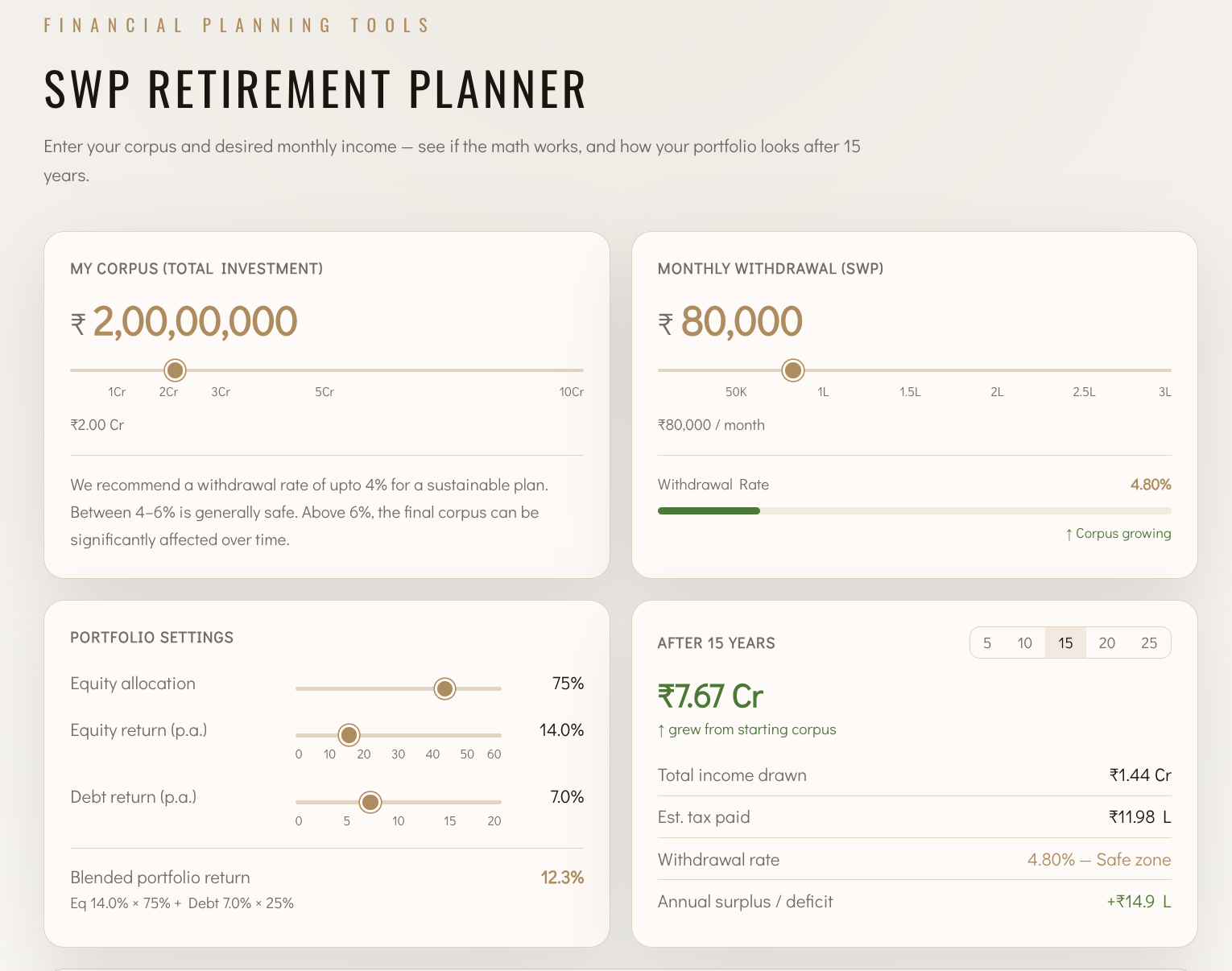
Entering a ₹2 crore corpus with an ₹80,000 monthly withdrawal works out to a 4.8% annual withdrawal rate, well within the "safe zone." This is illustrative only and not a promised outcome.
Want to see what your own corpus generates? Try our SWP Calculator →
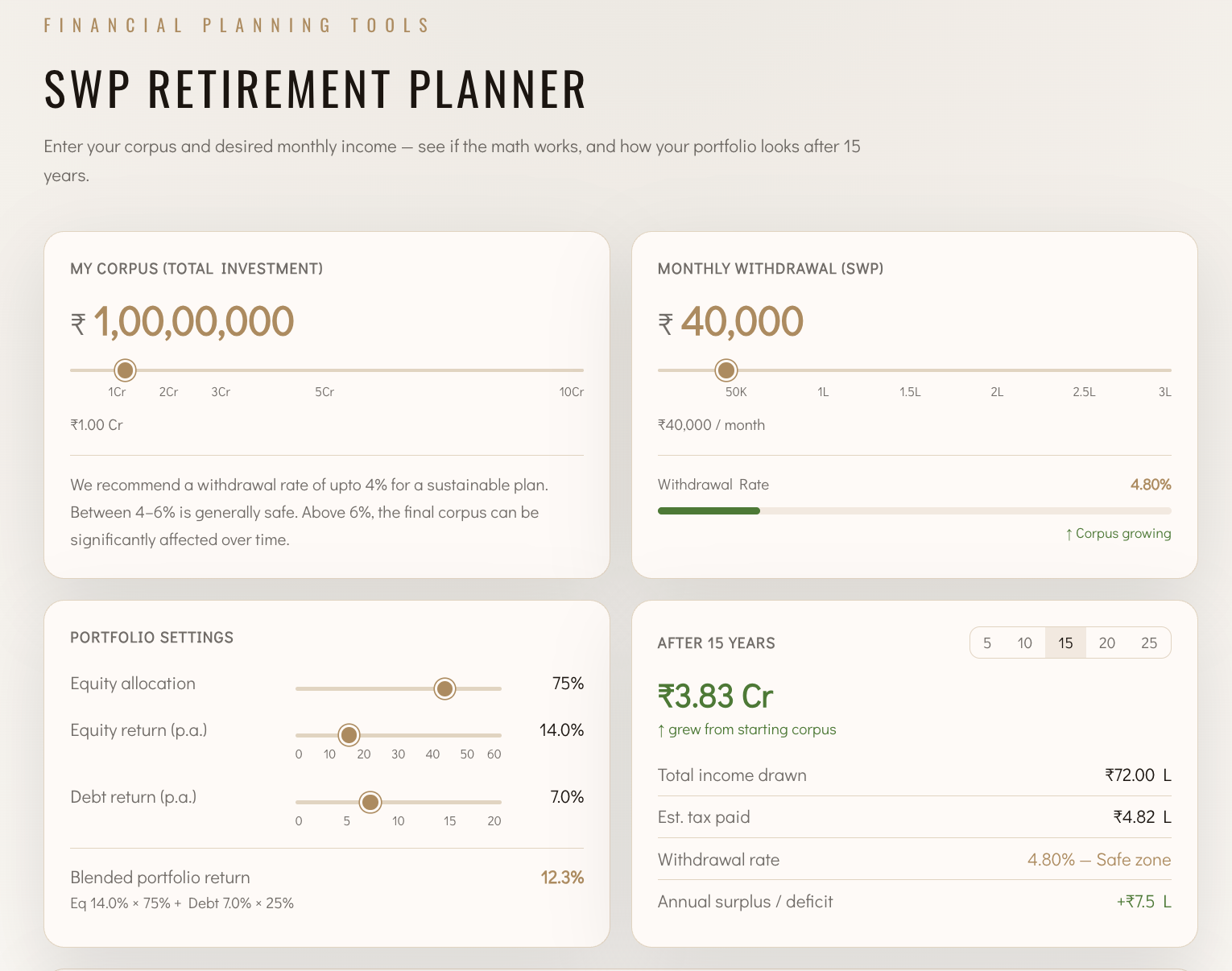
At the same 4.8% withdrawal rate, a ₹1 crore corpus needs a ₹40,000 monthly withdrawal, again illustrative only and dependent on actual market performance.
Want to see what your own corpus generates? Try our SWP Calculator →
Tier-2 cost of living varies quite a bit from one city to the next, and even within the same city depending on lifestyle. These numbers are a reasonable starting point, not a personalized answer for your specific situation, so it's worth working through your own realistic monthly expenses rather than assuming a generic average applies to you.
Where to Go From Here
For the full method behind sizing a retirement corpus from your own expenses, How Much Do You Really Need to Retire in India? walks through that calculation in detail. And if you're specifically weighing a ₹1 crore corpus with a regional lens, Can I Retire on ₹1 Crore? A Realistic Guide for Gujarat Investors covers the same question from a Gujarat-specific angle.
Frequently Asked Questions
Is ₹2 crore enough for retirement in a tier-2 city like Jaipur or Coimbatore?
For most households with moderate monthly expenses in the ₹40,000 to ₹60,000 range, ₹2 crore comfortably supports retirement in these cities, with some room for healthcare costs and lifestyle flexibility. Actual sufficiency depends on your specific expenses and any dependents you're supporting.
How long does 1 crore last after retirement?
It depends heavily on your withdrawal rate. At a conservative 3% rate, a ₹1 crore corpus can last 30 years or more; at a higher 6% rate, it can deplete in well under 20 years. There's no single fixed answer, since it's driven by the gap between withdrawal rate and actual investment returns.
What withdrawal rate should I use to make my corpus last longer?
A lower withdrawal rate, generally in the 3% to 3.5% range, tends to make a corpus last longer, at the cost of a smaller monthly income today. The right balance depends on how much income you need versus how much longevity you want to prioritize.
Does inflation affect how long a corpus lasts?
Yes, significantly. If your withdrawal amount increases each year to keep pace with inflation, as is typical in real retirement planning, the corpus depletes faster than a scenario with a fixed nominal withdrawal, which is why inflation-adjusted withdrawal rate research tends to be more conservative than headline nominal figures suggest.
Is a tier-2 city retirement genuinely cheaper than a metro?
Generally yes, particularly on housing, which is often the largest expense category. Overall cost of living in most tier-2 cities tends to run meaningfully lower than in India's largest metros, though the gap varies by city and lifestyle.
Want to talk?
If you'd like to work through your own specific expenses and corpus rather than these general estimates, get in touch with A2 Wealth.