
₹1 crore has a certain ring to it. It sounds like the number, the one that means you've made it, the one that means retirement is secure. Whether it actually is depends far less on the number itself and far more on where you live and what your life actually costs.
For someone planning to retire in Ahmedabad, Surat, Vadodara, or Rajkot, the honest answer to "is ₹1 crore enough" looks different than it would for someone planning to retire in Mumbai or Delhi. Let's work through it properly.
Quick Summary
Whether ₹1 crore is enough to retire on depends almost entirely on your expected monthly expenses and where you live, not on the ₹1 crore figure itself. This post covers:
- A direct answer to whether ₹1 crore is enough, grounded in Gujarat's cost of living
- Realistic monthly expense ranges for retired households in Gujarat's cities
- A worked example of what ₹1 crore could generate as monthly income
- What to do if ₹1 crore looks like it might fall short for your situation
Quick Answers
Is ₹1 crore enough to retire on in Gujarat? For many households in Ahmedabad, Surat, Vadodara, or Rajkot with moderate monthly expenses, ₹1 crore can support a reasonably comfortable retirement, though this depends heavily on your specific lifestyle, healthcare needs, and whether you're supporting dependents.
How much monthly income does a ₹1 crore corpus generate? Withdrawing ₹40,000 a month works out to a 4.8% annual withdrawal rate, comfortably within the "safe zone." This is illustrative only and not a guaranteed figure.
What if ₹1 crore looks like it won't be enough for me? A few practical levers can help: extending your SIP years before retiring, adjusting your withdrawal rate downward, or delaying retirement by a few years to build a larger corpus.
(Full answers to these and more are in the FAQ section below.)
Is ₹1 Crore Enough to Retire On?
Whether ₹1 crore is enough to retire on depends almost entirely on your expected monthly expenses and where you live, not on the ₹1 crore figure itself. The same corpus that comfortably funds a retirement in a Gujarat tier-1 or tier-2 city could fall short in Mumbai or Bengaluru, simply because the cost of maintaining an equivalent lifestyle differs so much between cities.
This is genuinely good news for Gujarat-based retirees. Cities like Ahmedabad, Surat, Vadodara, and Rajkot generally carry a meaningfully lower cost of living than India's largest metros, particularly on housing, which is often the single biggest expense category in retirement.
What Does Retirement Actually Cost in Gujarat's Cities?
A retired household in a Gujarat tier-1 or tier-2 city, owning their home outright and living moderately, might realistically expect monthly expenses somewhere in the ₹35,000 to ₹55,000 range, covering groceries, utilities, healthcare, and everyday living costs. This is noticeably lower than equivalent expenses in Mumbai or Delhi, where the same lifestyle can easily run 30% to 50% higher, largely due to housing and services costs.
These are general estimates, not a personalized budget, since actual expenses vary with lifestyle choices, whether you're still supporting children, and healthcare needs, which tend to rise with age.
A Worked Example: What ₹1 Crore Actually Generates
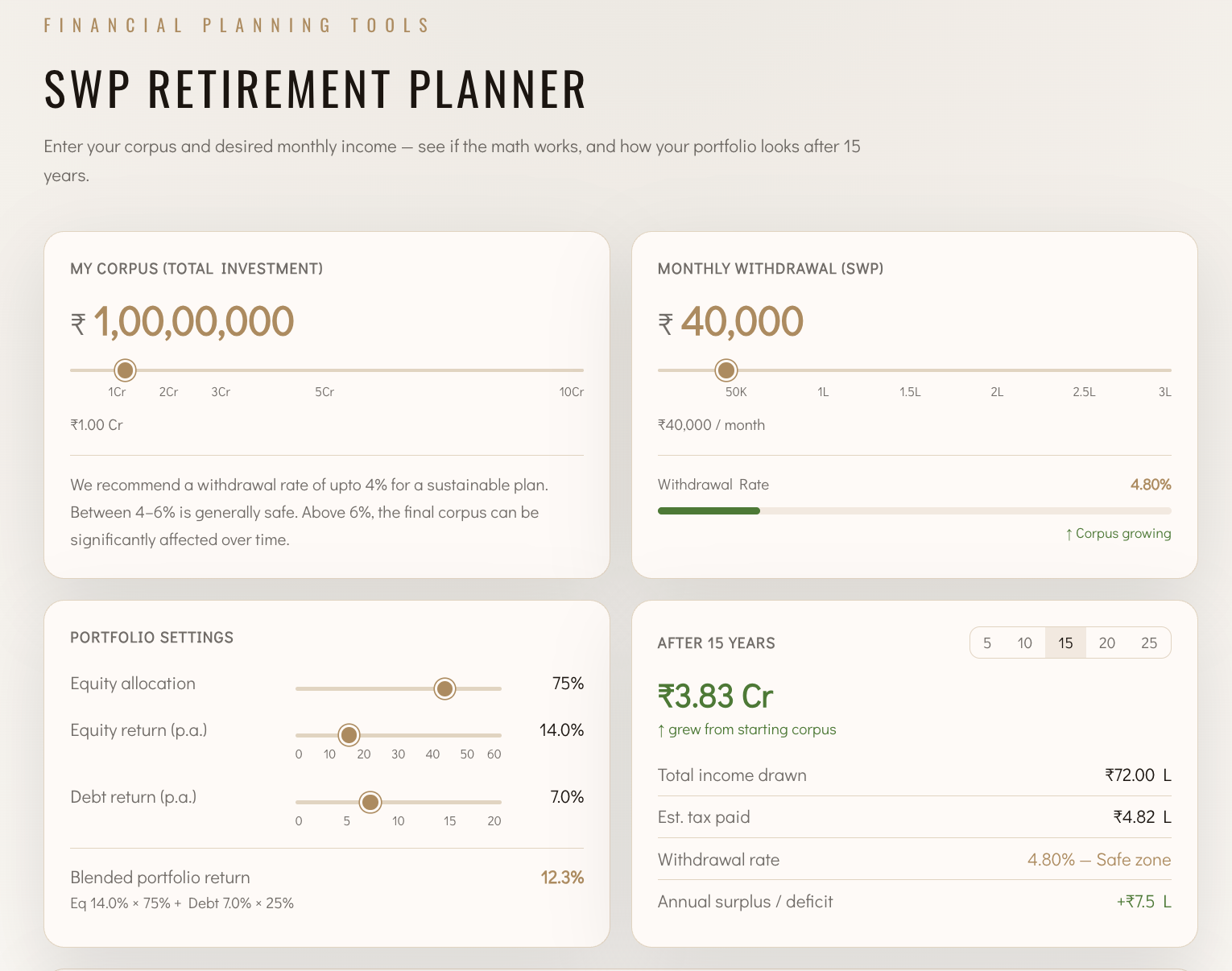
Entering a ₹1 crore corpus with a ₹40,000 monthly withdrawal works out to a 4.8% annual withdrawal rate, comfortably within the "safe zone." This is illustrative only, based on assumed rates of return, and actual outcomes will vary; past performance never guarantees future results.
Want to see what your own corpus generates? Try our SWP Calculator →
Compared against the ₹35,000 to ₹55,000 monthly expense range above, ₹1 crore at this withdrawal rate sits toward the lower-to-middle end of that range, comfortable if your expenses run modest, tighter if they run toward the top.
This math assumes a fairly typical Gujarat cost of living. If you're planning significant travel, supporting children studying or settled abroad, or anticipating substantial medical needs, the real number for your specific situation looks different, and it's worth working through your own expense estimate rather than relying on these general ranges.
What to Do If ₹1 Crore Looks Short
If your own numbers suggest ₹1 crore might not comfortably cover your expected expenses, a few practical adjustments are worth considering, without any need for alarm:
- Extend your SIP years. Even a few additional years of contributions before retiring can meaningfully grow your final corpus, thanks to compounding.
- Adjust your withdrawal rate. Choosing a more conservative rate, such as 3% instead of 4%, stretches the same corpus further, at the cost of a somewhat lower monthly income.
- Delay retirement by a few years. This gives your corpus more time to grow and reduces the number of years it needs to last.
None of these require a dramatic change of plans, just a realistic look at which lever makes the most sense for your specific timeline.
Where to Go From Here
For the full method behind sizing a retirement corpus from your expenses, rather than starting from a specific number like ₹1 crore, How Much Do You Really Need to Retire in India? walks through that calculation in detail. And if your ₹1 crore is currently sitting in fixed deposits, You're Retired and Living Off FD Interest: What It's Actually Costing You is worth reading alongside this one.
Frequently Asked Questions
Is ₹1 crore enough to retire on in Ahmedabad or Surat?
For many households with moderate monthly expenses in the ₹35,000 to ₹55,000 range, ₹1 crore can support a reasonably comfortable retirement in these cities, given their lower cost of living compared to metros. Your specific lifestyle and healthcare needs will shape where you actually land in that range.
How long does ₹1 crore last after retirement?
This depends on your withdrawal rate and investment returns relative to inflation. At a conservative withdrawal rate with a reasonable investment mix, a ₹1 crore corpus can last 25 to 30 years or longer; at a higher withdrawal rate, it can deplete considerably faster. There's no single fixed answer, since it depends on the specific rate and returns involved.
How much monthly income can I get from ₹1 crore?
Withdrawing ₹40,000 a month works out to a 4.8% annual withdrawal rate, which sits in the "safe zone." This figure is illustrative, based on assumed rates of return, and actual results depend on market performance and the funds chosen.
Is ₹1 crore enough if I'm supporting children or aging parents?
This adds meaningful expense on top of typical retirement living costs, and it's worth accounting for separately rather than assuming your base living expenses alone. Depending on the extent of support needed, ₹1 crore may or may not be sufficient, and a larger corpus or a more conservative withdrawal rate may be warranted.
What if I want to retire earlier than planned with only ₹1 crore?
Retiring earlier means the corpus needs to last longer and absorb more years of inflation, which generally calls for a more conservative withdrawal rate and a closer look at whether ₹1 crore truly covers your expected expenses over a longer retirement horizon.
Want to talk?
If you'd like to work through your own specific numbers rather than these general city-level estimates, get in touch with A2 Wealth.