
You've been tracking your EPF balance, maybe added up a rough estimate from your other investments, and you have a number in your head for what your retirement corpus might look like a decade or so from now. What you probably don't have yet is a clear sense of what that number actually means in monthly terms.
That's the gap this post is meant to close.
Quick Summary
The monthly income your retirement corpus can generate depends on your withdrawal rate and the returns your investments earn, not on the corpus size in isolation. This post covers:
- What actually decides your corpus's monthly income potential
- A worked planning example for someone in their late 40s or early 50s
- Why a conservative withdrawal rate matters more the further out retirement is
- What a generic calculator can't account for in your specific situation
Quick Answers
Does a bigger corpus always mean more monthly income? Not proportionally on its own. Two people with the same corpus can end up with very different sustainable monthly incomes depending on their withdrawal rate and how the money is invested.
What withdrawal rate should I plan around if I'm still 10+ years from retiring? A more conservative rate, often 3% to 3.5%, tends to make sense this far out, since you're planning against a corpus whose final size isn't fully known yet.
Can I just use an online SWP calculator to plan this? It's a good starting point for the math, but it assumes a single clean corpus. In practice, most people are combining EPF, NPS, mutual funds, and sometimes rental income, each taxed differently, which a generic calculator won't reflect.
(Full answers to these and more are in the FAQ section below.)
What Decides Your Retirement Corpus's Monthly Income?
The monthly income your retirement corpus can generate depends on your withdrawal rate and the returns your investments earn, not on the corpus size in isolation. Two people can retire with the same ₹1.5 crore corpus and end up with meaningfully different monthly incomes: one withdrawing conservatively from a well-structured mix of equity and debt, the other withdrawing aggressively from something less diversified. The corpus size is only the starting input; the withdrawal rate and the underlying investment mix determine what actually comes out of it each month.
A Worked Planning Example
Consider someone in their early 50s who's projected, based on their current EPF balance, mutual fund investments, and a few more years of contributions, that they'll retire with roughly ₹1.5 crore.
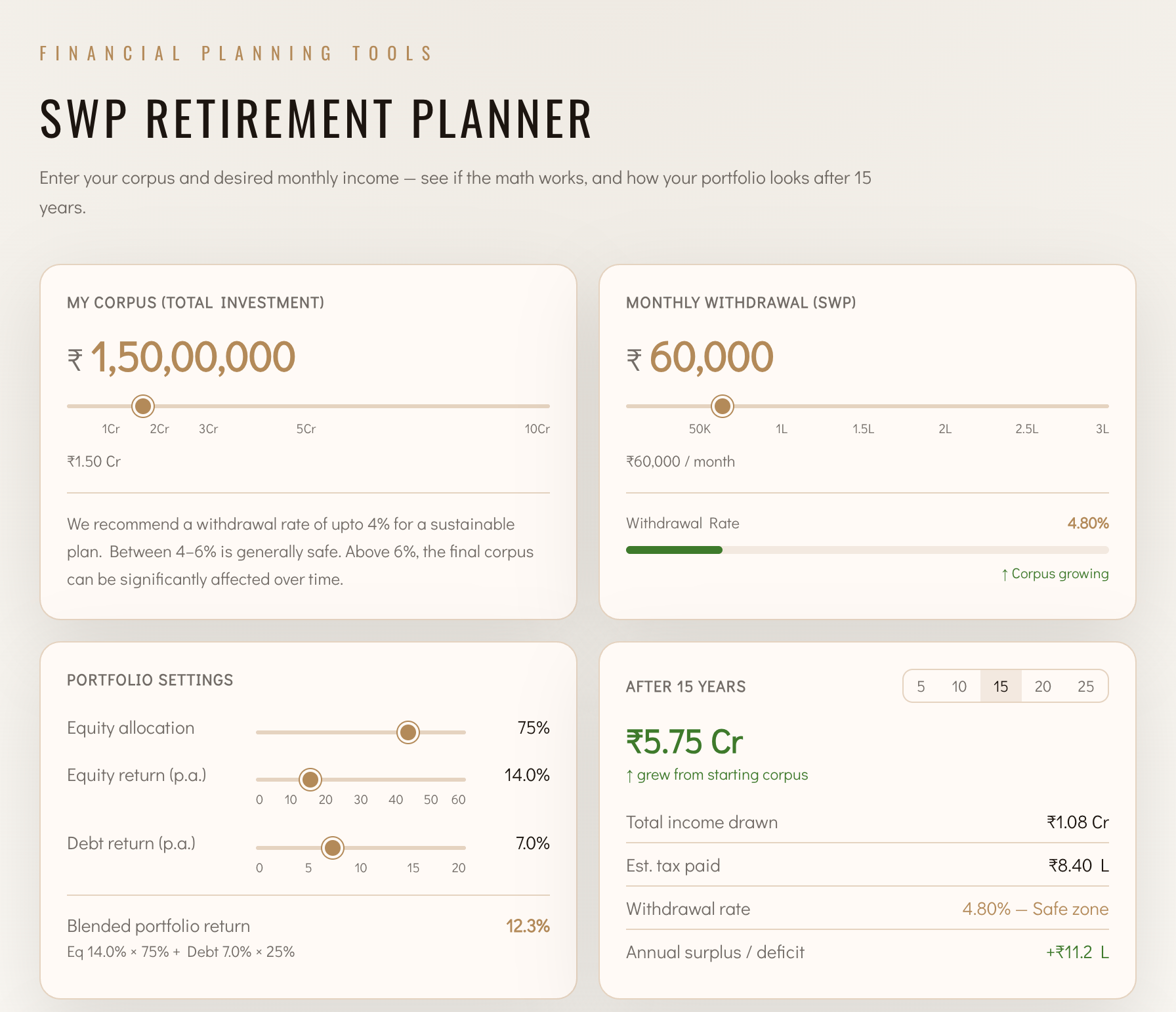
Entering a ₹1.5 crore corpus with a ₹60,000 monthly withdrawal works out to a 4.8% annual withdrawal rate, comfortably within the calculator's "safe zone." Illustratively, the corpus still grows to roughly ₹5.75 crore after 15 years, having paid out ₹1.08 crore in total income along the way. This is illustrative only, based on assumed rates of return, and actual outcomes will vary; past performance never guarantees future results.
Want to see what your own projected corpus generates? Try our SWP Calculator →
Why a Conservative Withdrawal Rate Matters More When Retirement Is Still Years Away
If you're still 10 or more years from retiring, there's a good case for planning around a more conservative withdrawal rate than someone retiring next year. The corpus you're projecting today is just that: a projection. Markets between now and then will have their own ups and downs, and the sequence of returns right around your actual retirement date matters more than most people expect. A downturn in the first few years of withdrawals can draw a corpus down faster than the same downturn happening later would.
Planning around a 3% to 3.5% withdrawal rate this far out builds in a cushion for that uncertainty, rather than assuming your final numbers will match today's projection exactly.
This math assumes a single clean corpus, which is rarely how it actually looks in practice. Most people in their 40s and 50s are combining EPF, possibly NPS, mutual fund investments, and sometimes rental income, each of which is taxed differently and withdraws or matures on its own schedule. Coordinating those pieces into one coherent monthly income plan is exactly the part a generic calculator can't do for you.
Where to Go From Here
If you haven't yet nailed down what your target corpus size should even be, How Much Do You Really Need to Retire in India? walks through that calculation from expenses backward, which is a useful starting point before projecting monthly income.
Frequently Asked Questions
How do I calculate the monthly income from my retirement corpus?
Multiply your projected corpus by your chosen annual withdrawal rate, then divide by 12. For example, a ₹1.5 crore corpus with a ₹60,000 monthly withdrawal works out to a 4.8% withdrawal rate. The withdrawal amount you choose should reflect how conservative you want to be given your time horizon.
What withdrawal rate is realistic for retirement income planning in India?
Many planners suggest a range of 3% to 4%, with the more conservative end favored when retirement is still many years away, given India's inflation history and the added uncertainty of projecting a corpus that far in advance.
How much corpus do I need for a specific monthly income, like ₹60,000?
Divide your desired monthly income by your chosen withdrawal rate (as a monthly figure) to estimate the corpus needed. At a 4.8% annual withdrawal rate, generating ₹60,000 a month requires roughly ₹1.5 crore, though this is an illustrative estimate, not a guaranteed figure.
Should I combine EPF, NPS, and mutual funds into one withdrawal plan?
They should be planned together conceptually, since each has different tax treatment, withdrawal rules, and maturity timing, but they typically aren't combined into a single withdrawal mechanism. Understanding how they'll work together is part of proper retirement income planning.
How often should I revisit my retirement income projections?
At least once a year, and additionally whenever your corpus, goals, or expected retirement date change meaningfully. A projection made a decade out is a starting estimate, not a fixed plan.
Want to talk?
If you'd like help mapping your specific mix of EPF, NPS, mutual funds, and other income sources into one coherent retirement income plan, get in touch with A2 Wealth.