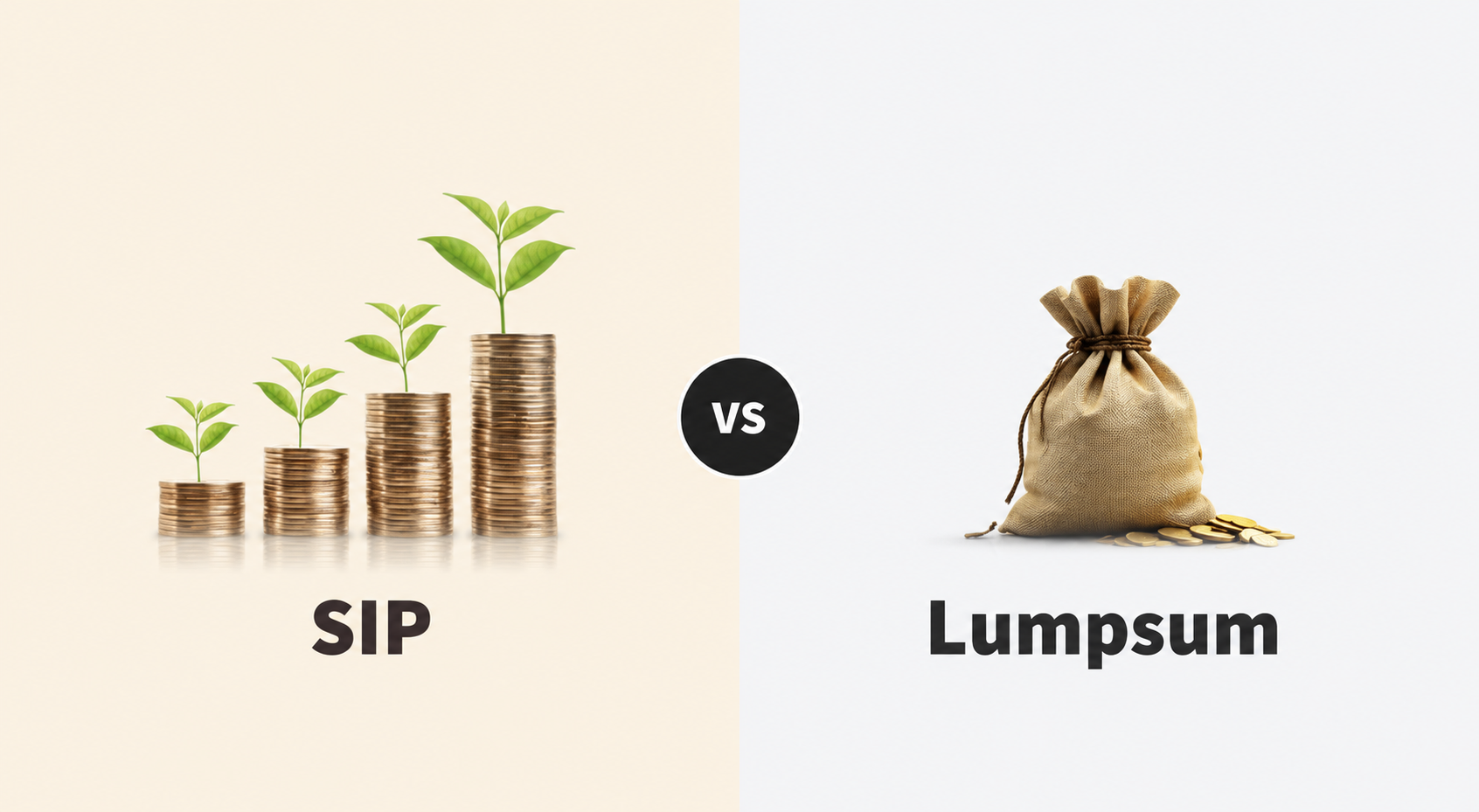
You've got a lump sum sitting in your account, maybe a bonus, a maturity payout, an inheritance, and a decision you haven't had to make before: put it all in now, or spread it out over time. Both options feel a little uncertain, and there's no shortage of confident opinions online telling you exactly what to do.
Here's a more honest answer: it depends, and the reasons why are worth actually understanding rather than just picking whichever approach sounds more disciplined.
Quick Summary
A SIP invests a fixed amount at regular intervals regardless of market level; a lumpsum invests the entire amount at once. Neither is universally better. This post covers:
- The actual mechanical difference between the two approaches
- When a lumpsum tends to work better, and when a SIP tends to work better
- What historical research across market cycles actually shows
- A practical middle path if you don't want to choose one extreme
Quick Answers
Is SIP or lumpsum better for investing a bonus? Neither is universally better. A lumpsum invests everything immediately, capturing more upside if markets rise steadily; a SIP spreads the investment out, reducing the risk of investing everything right before a downturn.
What is rupee-cost averaging? It's the effect of a SIP buying more units when prices are low and fewer when prices are high, since you're investing the same amount each time, which averages your purchase cost over the investment period.
Is there a middle path between SIP and lumpsum? Yes. An STP (Systematic Transfer Plan) lets you park a lumpsum in a liquid fund and transfer it gradually into equity over a few months, combining some of the benefits of both approaches.
(Full answers to these and more are in the FAQ section below.)
SIP vs. Lumpsum: What's the Actual Difference?
A SIP invests a fixed amount at regular intervals regardless of market level, while a lumpsum invests the entire amount at once. The practical difference is that a SIP averages your purchase price over time, a mechanic called rupee-cost averaging, reducing the risk of investing everything right before a downturn. A lumpsum is fully invested from day one, which means it captures more upside if markets rise steadily from the start, but also carries the full risk of a downturn immediately after investing.
Neither mechanic is inherently superior. Each simply behaves differently depending on what markets happen to do after you invest, which isn't something you can know in advance.
When a Lumpsum Investment Tends to Work Better
A lumpsum tends to work out better when markets rise steadily over your investment horizon, since being fully invested from day one captures the entire move rather than averaging into it gradually. It also suits investors who are genuinely comfortable with the possibility of a near-term dip and won't be tempted to react emotionally if their investment shows a paper loss shortly after investing.
When a SIP Tends to Work Better
A SIP tends to work out better when markets are volatile or declining over the period you're investing, since spreading the investment out means you're not exposed to the full downside immediately. It also suits investors who would find a lumpsum's short-term swings genuinely stressful, since the psychological comfort of easing in gradually often matters as much as the pure math.
What Does the Research Actually Show?
Historical comparisons across different market cycles, rising, falling, and sideways, generally show that lumpsum investing has outperformed SIP investing in a majority of historical periods, largely because markets have risen more often than they've fallen over long stretches. This is backward-looking research, though, not a predictive guarantee, and it doesn't account for an individual investor's actual behavior: a SIP that gets stuck to consistently often outperforms a lumpsum decision an investor later regrets and reacts to emotionally.
In other words, the theoretically better approach and the approach an individual investor can actually stick with aren't always the same thing, and the second one matters more in practice than it might seem on paper.
A Practical Middle Path: STP
If neither extreme feels right, a Systematic Transfer Plan (STP) offers a middle ground. Instead of choosing between investing everything today or spreading it out directly, you park the lumpsum in a liquid fund first, then set up automatic transfers into your equity fund of choice over a period of months. This gives you some of a SIP's downside protection during the transfer period while still getting the lumpsum invested in full within a defined, relatively short timeframe rather than dragging it out over years.
Frequently Asked Questions
SIP or lumpsum, which is better?
Neither is universally better. A lumpsum tends to work out better in steadily rising markets, while a SIP tends to work out better in volatile or declining markets. The more practical consideration is often which approach you can actually stick with without reacting emotionally to short-term swings.
I just got a bonus or inheritance. Should I invest it all at once?
It depends on your comfort with a near-term dip and your view on current market valuations, though an honest answer is that nobody can reliably predict short-term market direction. A Systematic Transfer Plan is a reasonable middle path if you want to avoid committing everything at once.
What is rupee-cost averaging and does it actually help?
Rupee-cost averaging is the effect of a fixed periodic investment buying more units when prices are low and fewer when prices are high, averaging your cost over time. It genuinely reduces the risk of poor timing, though it can also mean missing out on some upside if markets rise steadily throughout the investment period.
Does a SIP guarantee better returns than a lumpsum?
No. Historical comparisons across market cycles generally show lumpsum investing outperforming SIP investing in a majority of periods, since markets have risen more often than they've fallen historically. This is backward-looking, not predictive, and doesn't guarantee any specific future outcome.
How does an STP work as a middle path between SIP and lumpsum?
You invest the lumpsum into a liquid fund first, then set up automatic periodic transfers from that liquid fund into your chosen equity fund over a defined period, typically a few months. This spreads out your entry into equity while still getting the full amount invested within a relatively short, defined timeframe.
Want to talk?
If you'd like help thinking through your own specific situation before deciding, get in touch with A2 Wealth. And if you want the deeper case for staying invested long enough for either approach to pay off, The Power of Compounding and Long-Term Investing is worth reading alongside this one.