
If you're reading this, you probably already have a number in mind: ₹50 lakh, ₹1 crore, or ₹2 crore, sitting in savings, maturing FDs, or a retirement payout, and you want to know what it could actually generate as a monthly income. Not a vague estimate. An actual number you can plan around.
This post gives you that number for all three corpus sizes, along with the mechanics behind it, so you can see where the number comes from rather than just taking it on faith.
Quick Summary
An SWP lets you withdraw a fixed amount every month from a mutual fund investment, drawing from a mix of capital and growth. You enter your corpus and desired monthly withdrawal amount, and the calculator works out your withdrawal rate and what happens to your corpus over time. This post walks through:
- What an SWP is and how the resulting withdrawal rate changes the outcome
- Worked monthly income examples for ₹50L, ₹1Cr, and ₹2Cr corpus sizes
- Why the withdrawal rate matters more than the corpus size alone, including how it stacks up against long-term mutual fund return history
- The honest risks, including a real example of a corpus running out
Quick Answers
What monthly income can a ₹1 crore corpus generate through an SWP? Withdrawing ₹40,000 a month from a ₹1 crore corpus works out to a 4.8% annual withdrawal rate, comfortably within our calculator's "safe zone." This is illustrative only, based on assumed rates of return, and not a promised outcome.
What withdrawal rate should I use in an SWP? Our calculator's own guidance: up to 4% is a genuinely sustainable pace, 4% to 6% is generally safe, and above 6% your final corpus can be significantly affected over time.
Is the monthly SWP amount fixed forever? Not automatically. You set a monthly rupee amount, not a fixed percentage, and can revise it periodically as your corpus and needs change, unlike a fixed deposit's contracted interest rate.
(Full answers to these and more are in the FAQ section below.)
What Is an SWP and How Does It Work?
An SWP, or Systematic Withdrawal Plan, lets you withdraw a fixed amount from a mutual fund investment at regular intervals, typically monthly. Unlike a fixed deposit, where the bank pays you a set interest rate on an untouched principal, an SWP draws money out of an investment that stays invested and continues to grow or shrink based on market performance.
Each withdrawal is a mix of your original capital and whatever growth the fund has generated. In practice, most SWP calculators, ours included, ask you to set a corpus and a desired monthly withdrawal amount in rupees, then calculate the resulting withdrawal rate for you, rather than asking you to pick a percentage directly. That withdrawal rate is still the single most important number in this equation: a lower rate means a smaller monthly income today, but a corpus that's more likely to last longer or even grow. A higher rate means more money in hand now, at the cost of drawing down the corpus faster.
With that mechanic in mind, here's what it looks like across three common corpus sizes.
₹50 Lakh Corpus: What It Generates
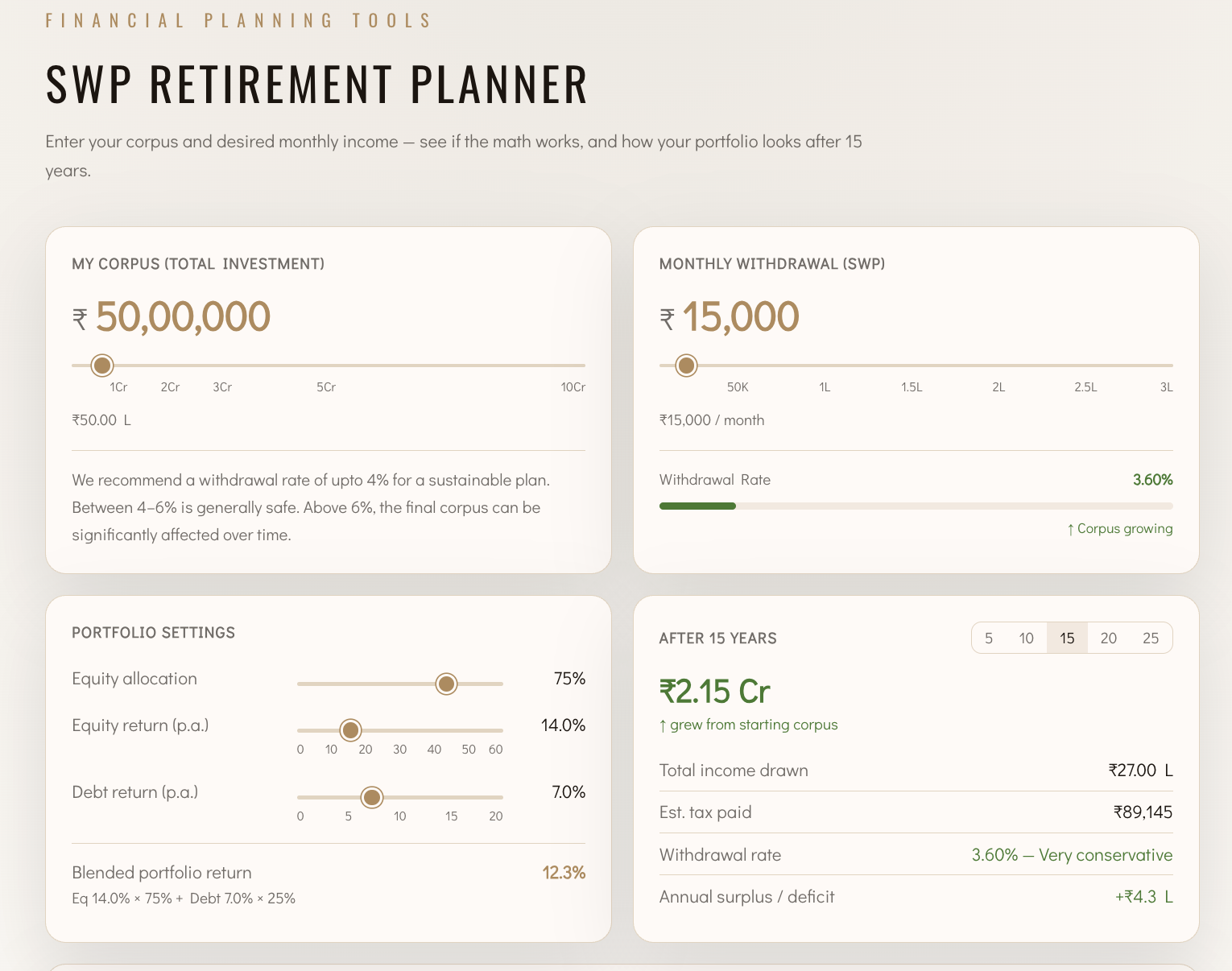
Entering a ₹50 lakh corpus with a ₹15,000 monthly withdrawal works out to a 3.6% annual withdrawal rate, which our calculator flags as "very conservative." Illustratively, assuming a 75% equity / 25% debt mix (a 12.3% blended return), the corpus actually grows to approximately ₹2.15 crore after 15 years, having paid out ₹27 lakh in total income along the way. This is illustrative only, based on assumed rates of return, and actual outcomes will vary; past performance never guarantees future results.
Want to see what your own corpus generates? Try our SWP Calculator →
₹1 Crore Corpus: What It Generates
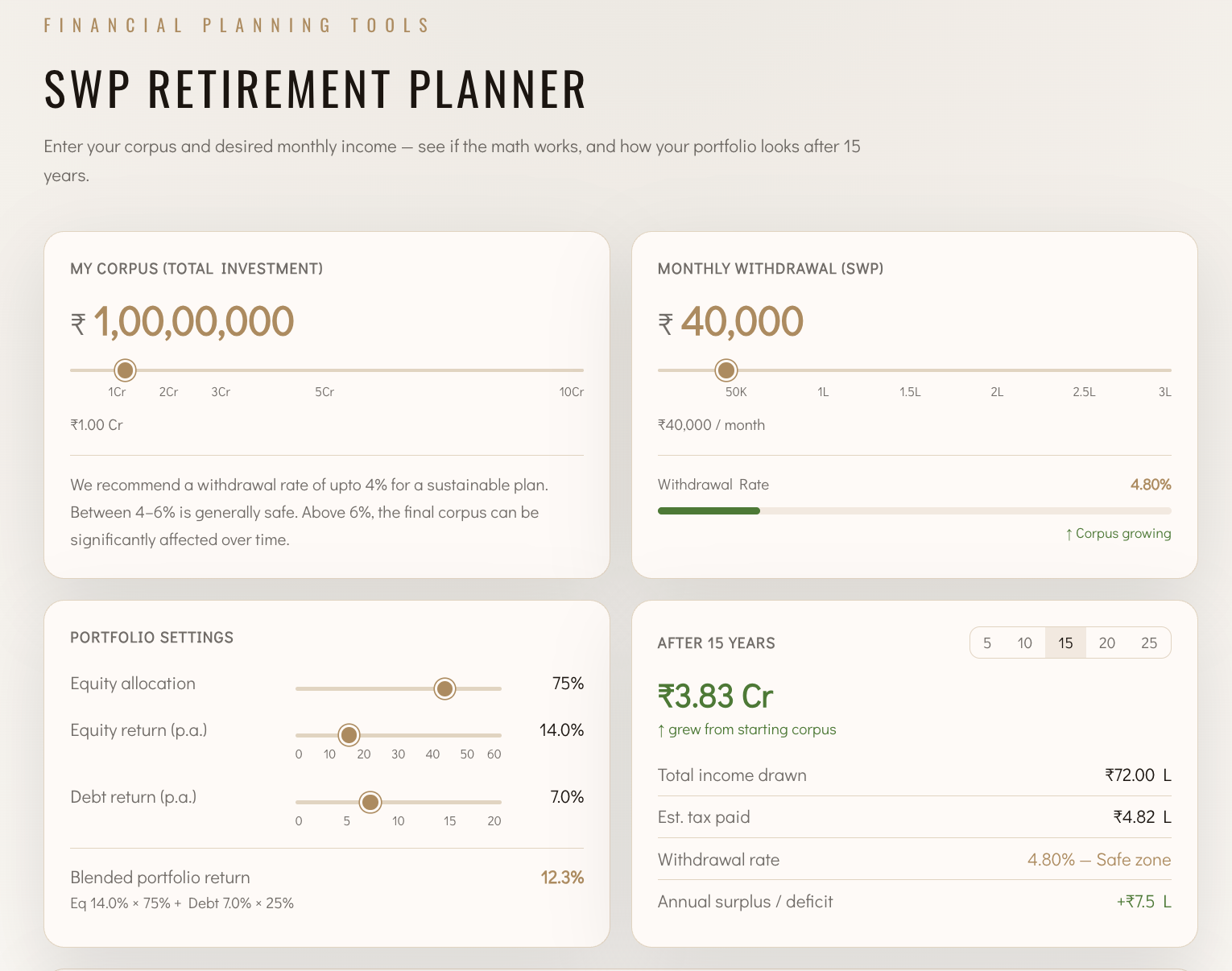
Entering a ₹1 crore corpus with a ₹40,000 monthly withdrawal works out to a 4.8% annual withdrawal rate, within the calculator's "safe zone." Illustratively, the corpus grows to approximately ₹3.83 crore after 15 years, after paying out ₹72 lakh in total income. This is illustrative only, based on assumed rates of return, and actual outcomes will vary; past performance never guarantees future results.
Want to see what your own corpus generates? Try our SWP Calculator →
₹2 Crore Corpus: What It Generates
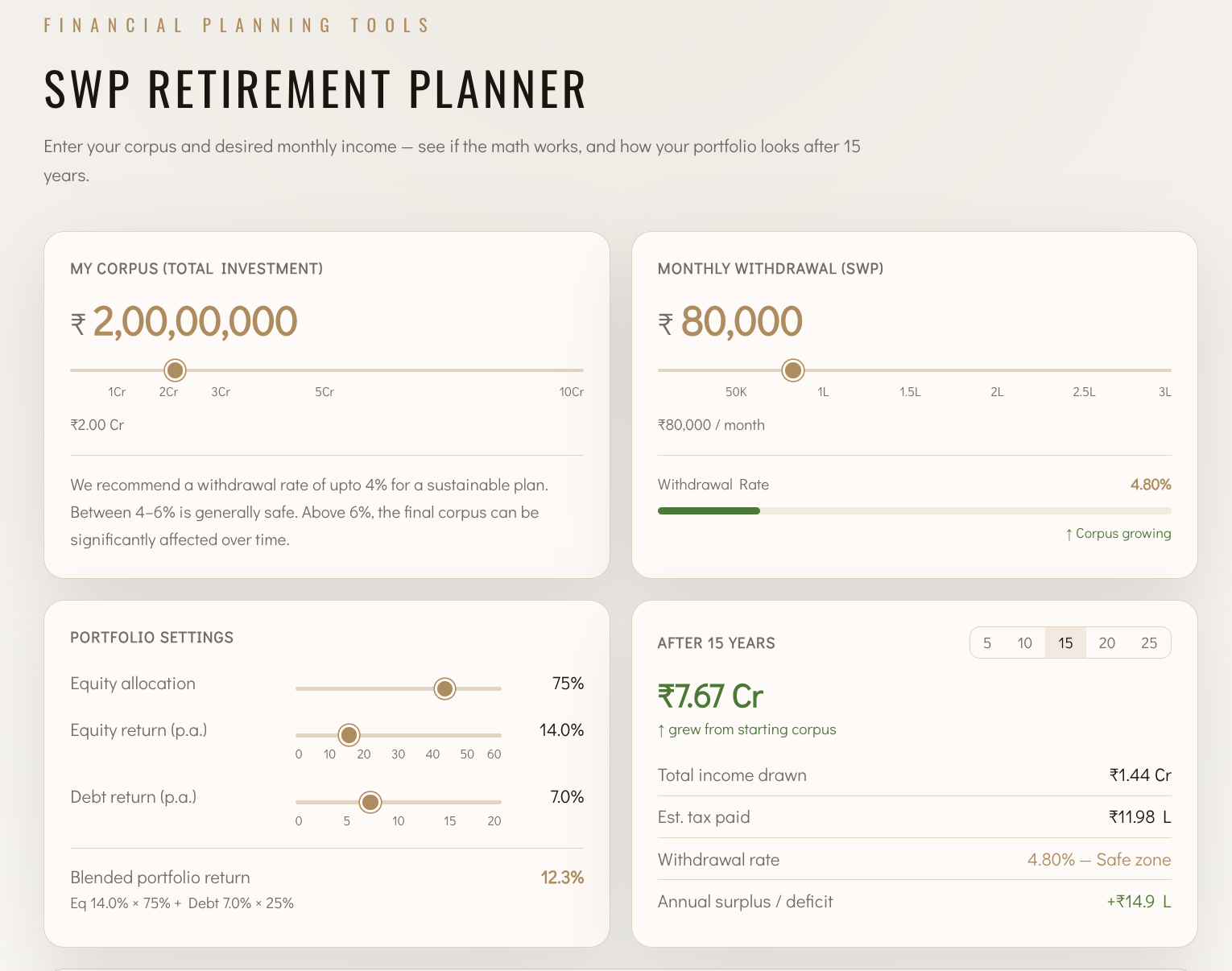
Entering a ₹2 crore corpus with an ₹80,000 monthly withdrawal also works out to a 4.8% annual withdrawal rate. Illustratively, the corpus grows to approximately ₹7.67 crore after 15 years, after paying out ₹1.44 crore in total income. This is illustrative only, based on assumed rates of return, and actual outcomes will vary; past performance never guarantees future results.
Want to see what your own corpus generates? Try our SWP Calculator →
Why Withdrawal Rate Matters More Than the Headline Number
It's easy to fixate on the monthly rupee figure and forget that it comes from a choice you're making, not a fixed law of physics. Using the same ₹1 crore corpus and a 75% equity / 25% debt mix (a 12.3% blended illustrative return), here's what happens after 15 years as the monthly withdrawal amount increases:
| Monthly Withdrawal | Withdrawal Rate | Corpus After 15 Years | What It Means |
|---|---|---|---|
| ₹25,000 | 3.0% | ₹4.52 Cr | Very conservative: corpus more than quadruples |
| ₹30,000 | 3.6% | ₹4.29 Cr | Very conservative: corpus keeps compounding strongly |
| ₹40,000 | 4.8% | ₹3.83 Cr | Safe zone: corpus still grows comfortably |
| ₹50,000 | 6.0% | ₹3.38 Cr | Safe zone (upper end): growth slows but continues |
| ₹75,000 | 9.0% | ₹2.24 Cr | Aggressive: corpus still grows, but much more slowly |
| ₹1,00,000 | 12.0% | ₹1.10 Cr | Aggressive: corpus barely holds its ground |
| ₹1,25,000 | 15.0% | Depleted in year 15 | Withdrawals now outpace growth entirely |
These figures are illustrative only, based on the calculator's assumed 12.3% blended annual return, and are not a guarantee of any actual outcome.
Notice where the pattern breaks: at a 12% withdrawal rate, the corpus barely moves over 15 years, from ₹1 crore to about ₹1.10 crore, because 12% sits almost exactly at the assumed blended return. That's not a coincidence. As long as your withdrawal rate stays meaningfully below your investments' long-term average return, the corpus keeps compounding upward even after your withdrawals. Push the withdrawal rate close to or above that return, and withdrawals start outpacing growth, and the corpus stalls, then shrinks.
Long-term, diversified equity mutual fund categories have historically delivered somewhere in the range of 12% to 20%+ CAGR over 15 to 20 year periods, depending on the category and risk taken (see our piece on the power of compounding for the full data). That context is exactly why a withdrawal rate in the low single digits leaves so much room for a corpus to grow.
Here's the important caveat, though: this crossover math assumes a smooth, constant annual return every single year, which real markets never actually deliver. A bad sequence of returns early in your withdrawal years, a downturn in year 2 or 3 rather than year 12, can deplete a corpus far faster than an average-return model suggests, even at a withdrawal rate that looks perfectly safe on paper. This is exactly why the calculator's own guidance is more conservative than the raw crossover point: up to 4% is considered genuinely sustainable, 4% to 6% is generally safe, and above 6%, the final corpus can be significantly affected over time.
There's a second factor working against every one of these numbers too: inflation. A fixed monthly withdrawal amount that feels comfortable today will buy noticeably less a decade from now, since prices keep rising while a fixed nominal amount doesn't. This is exactly why many retirees choose a withdrawal rate on the more conservative end, and why the number you pick today is worth revisiting periodically rather than setting once and forgetting.
The Honest Risks
None of the numbers above are guaranteed. An SWP draws from a market-linked investment, so the corpus can grow, shrink, or behave unpredictably, especially in the early years of withdrawal, when a market downturn combined with fixed withdrawals can draw the corpus down faster than expected, sometimes called sequence-of-returns risk.
Here's what that actually looks like. Withdrawing ₹1,25,000 a month from the same ₹1 crore corpus, a 15% withdrawal rate, depletes the corpus entirely by year 15, even at the calculator's assumed 12.3% blended return:
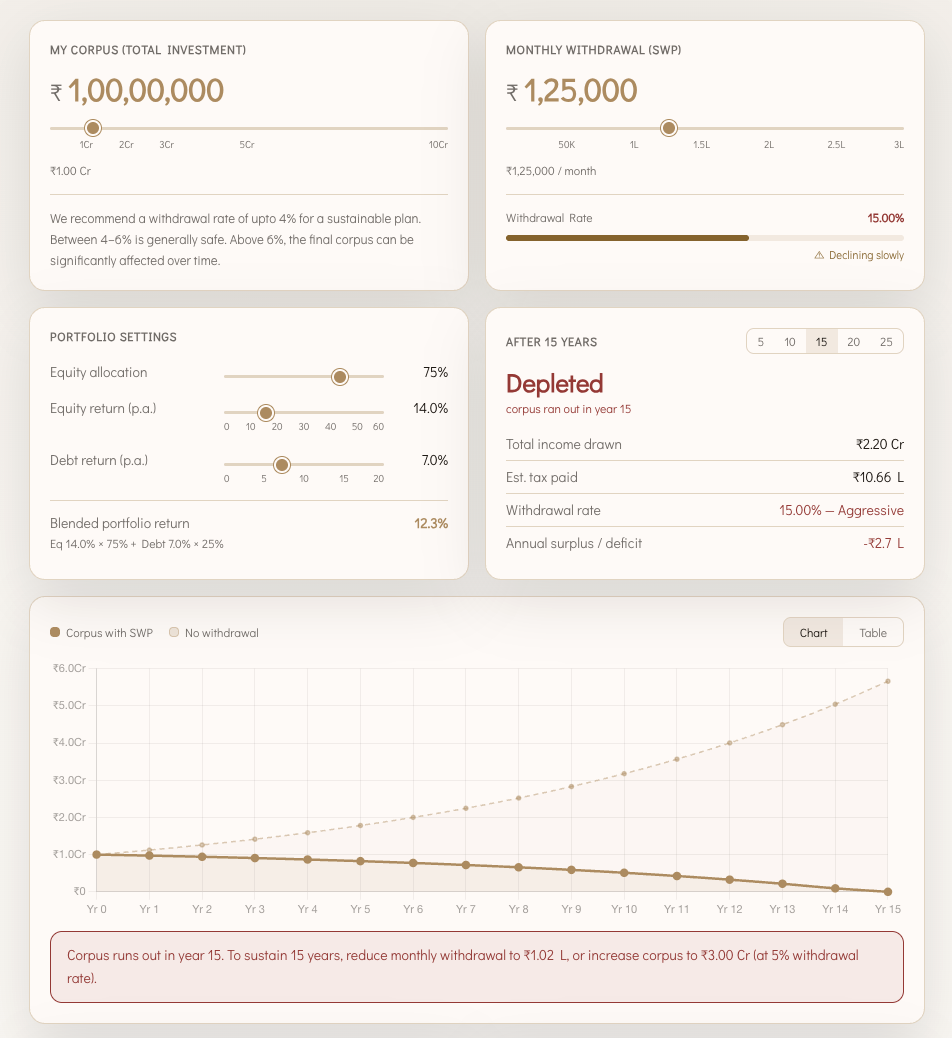
The chart makes the mechanism obvious: the "no withdrawal" line keeps compounding upward, while the "corpus with SWP" line falls further behind every year until it hits zero. The calculator's own suggestion in this scenario: to sustain 15 years at this withdrawal amount, you'd need to either reduce the monthly withdrawal to roughly ₹1.02 lakh, or increase the corpus to ₹3 crore at a 5% withdrawal rate instead.
This is why an SWP is a genuine tradeoff against something like a fixed deposit, not a strictly better replacement. It offers the potential for better tax treatment and a corpus that can outpace inflation, in exchange for giving up the guarantee that a fixed deposit's principal carries.
Want to know what your specific corpus and situation would actually generate? We'll walk through it honestly. This isn't a generic calculator result. It's about the withdrawal amount, fund mix, and timeline that make sense for you specifically. Talk to A2 Wealth →
Where to Go From Here
If you're comparing this against a corpus currently sitting in fixed deposits, You're Retired and Living Off FD Interest: What It's Actually Costing You walks through that comparison directly.
If you haven't settled on a target corpus size yet and want to plan further ahead, How Much Monthly Income Will My Retirement Corpus Generate? A Planning Guide for Your 40s and 50s is the right next stop.
Frequently Asked Questions
How much monthly income can I get from an SWP on a ₹50 lakh corpus?
There's no single figure, since it depends on the withdrawal rate you choose. Withdrawing ₹15,000 a month (a 3.6% rate) is considered very conservative and, in illustrative modeling, actually left the corpus growing to about ₹2.15 crore after 15 years. A higher monthly amount generates more income now but draws down the corpus faster.
How much monthly income can I get from an SWP on a ₹1 crore corpus?
It depends on your withdrawal rate. ₹40,000 a month (4.8%) sits in the calculator's "safe zone" and, illustratively, still lets the corpus grow to roughly ₹3.83 crore after 15 years. Pushing the withdrawal amount higher increases income now but slows or reverses that growth, as shown in the withdrawal-rate table above.
How much monthly income can I get from an SWP on a ₹2 crore corpus?
At a similar 4.8% withdrawal rate, an ₹80,000 monthly withdrawal on a ₹2 crore corpus illustratively grows to roughly ₹7.67 crore after 15 years. As with any market-linked estimate, actual results depend on market performance and the funds chosen.
What withdrawal rate should I choose for my SWP?
Our calculator's own guidance: up to 4% is a genuinely sustainable pace, 4% to 6% is generally safe, and above 6% the final corpus can be significantly affected over time. This is more conservative than the pure math would suggest, deliberately, to build in a buffer against a bad sequence of early returns.
Can I enter a withdrawal rate directly into the SWP calculator?
No. The calculator asks for your corpus and a desired monthly withdrawal amount in rupees, then calculates and displays the resulting withdrawal rate for you, along with a quick label (very conservative, safe zone, aggressive) so you can gauge sustainability at a glance.
Can I change my SWP amount later, or is it fixed like an FD?
You can revise an SWP's monthly withdrawal amount periodically, unlike a fixed deposit's contracted interest rate. This flexibility is useful as your expenses or the corpus's performance change over time, though frequent changes should still be planned rather than reactive.
Want to talk?
If you'd like to work through these numbers against your own actual corpus and goals, get in touch with A2 Wealth for an honest conversation.